































Join On The Issues

Receive information and updates via email.

On You Tube

Visit On The Issues Magazine's YouTube Channel

Send us links to your favorite, progressive videos to add to our favorites

Featured Video:

Featured Video: Intimate Wars by Merle Hoffman
OTI Online
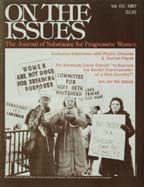
Volume 7, 1987

The Crusade of Karen Thompson
by Merle Hoffman


For Karen Thompson, the personal has indeed become the political; and for someone like Karen - a very private person who was never issue-oriented - the path to activism has resulted in an upheaval of her entire life.

The story of Karen Thompson and Sharon Kowalski began as a love story and has become, and continues to be, a nightmare - a nightmare that could happen to any of us. This is a tale of horror that one would think could have occurred only in a repressive regime - something out of Nazi Germany. Instead, it is happening here, today, in the United States.

Because this story is one of the most important we've ever heard - a chilling abrogation of patients' rights, disability rights, gay rights - indeed, all human rights - we are doing it in two parts: a synopsis of the background in Volume VII and the two-hour interview On The Issues conducted with Karen Thompson in Volume VIII.

Karen Thompson
Karen Thompson

For four years, Karen Thompson and Sharon Kowalski lived as more than lovers. As far as they were concerned, they were married. They had exchanged rings in their own private ceremony because they are both conventional people and, as Karen says, "We figured we were married in our eyes and in the eyes of God, and we were very much brought up to believe in the institution of marriage."

Then, on November 13. 1983. the nightmare began. Sharon's car was smashed by a drunk driver, leaving her a quadriplegic and unable to speak. To this day. the extent of her mental disability has yet to be determined. She suffered a closed-head injury, which means that some brain cells have been permanently damaged while others can be re-trained.

The accident forced Karen to "come out of the closet". Says Karen: "I 'came out' nationally before I came out to myself ... I'd lived with Sharon for four years and only admitted that I happened to fall in love with a human being because of certain qualities or characteristics. I had never admitted to myself that I was gay."

Her first taste of the agony to come was when the hospital wouldn't tell her if Sharon was dead or alive. The second was when the hospital psychologist suggested she "come out" to Sharon's parents. The Kowalskis responded that Karen was a crazy woman and was never to see their daughter again. At that point. Karen saw an attorney, only to learn that she had no legal rights as far as Sharon was concerned. The Kowalskis sued for guardianship, claiming that Karen was just Sharon's landlady and that their daughter was not a lesbian.

Fortunately, Karen was able to prove their relationship in court, due to the testimony of the few people Sharon had told, and the court permitted Karen visitation rights. At that time. Sharon was in St. Cloud Hospital, Minnesota in the city where she and Karen lived, and where Karen is an assistant professor at St. Cloud University. Karen has also studied occupational and physical therapy, and while Sharon remained in St. Cloud, Karen was able to work with her for hours every day. Slowly and continuously. Sharon began to show improvement. Videotapes prove that she was able to feed herself a little bit and type out responses with one hand when asked questions. Sharon indicated that she wanted to go home with Karen, and expressed fear that Karen would be taken from her. In September, 1984, that's just what happened. Donald Kowalski successfully filed to have Sharon moved to Duluth, 150 miles away.

In July, 1985, Sharon was again moved - to a nursing home in Hibbing. Minnesota, despite the fact that the home has no young adult rehabilitation program. Without such a program. Sharon cannot receive the treatment she needs to retain the progress Karen helped her achieve, to say nothing of progressing further. And, despite Sharon's expressed Wish to see her, Karen has been barred from the facility. She has not seen Sharon since August 19. 1985. According to Karen: "This is the United States and I'm not allowed to get any information on how she's doing. I cannot communicate with her in any way. I'll get arrested if I step on the premises."

Karen says her concern is not who gets legal guardianship of Sharon, but to insure that Sharon gets the best care possible. Because Karen is willing to take Sharon home, set up a rehabilitation program and work with her, while Sharon's parents are letting her vegetate in a nursing home, Karen believes that Sharon's basic right to recovery is being violated.

The Minnesota Civil Liberties Union is fighting for Karen's cause. She has wanted support from disability rights groups, but says: "Most of the groups I've talked with have agreed that Sharon's disability rights are being flagrantly violated. The problem seems to be that they have enough problems fighting for disability rights without getting involved in a case that has gay rights attached to it... My contention is that they can't afford not to get involved."

Except for the gay press, the Thompson case has received little media coverage - almost none in the major media - which is remarkable considering the issues involved. Karen has been traveling the country, trying to set up interviews and give speeches to enlist support for what has become a crusade. She knows that the issues are far beyond the fight for the custody and care of Sharon.

5ays Karen: "I've had the blinders ripped off. I can no longer live in my little isolated world and go to work and then, after work, live my own personal life and nobody knows me. I was very non-issue oriented. But once you do have the blinders taken off. you see oppression in one area, then you start to see oppression all around you. and it's almost overwhelming. Now. I not only see what homophobia does to people and how it can be used against them, but also I can make the tie to racism, sexism, ageism, the disabled - it's all connected. And I didn't know that before ... I'm a totally different person now and I'll never be able to go back to the person that I was."

In addition to the emotional and physical drain Karen is suffering, the financial drain has been enormous. Her legal fees alone are nearly $100,000. She is grateful to the University that they have not only kept her on. but have also been very supportive. She will continue to fight, no matter what the cost, because "If Sharon and I don't fight this, then how many others will have to experience it because we didn't? It's got to stop somewhere."

(For information or contributions contact MnGALLA. c/o Suzanne Born. 3436 Holmes Ave., Minneapolis. MN 55408)


Merle Hoffman is publisher/editor-in-chief of On The Issues magazine and founder/president of both Choices Women's Medical Center, Inc., and Choices Mental Health Center.


The Cafe

deepening the conversations by continually adding the insights of progressive writers.

Newest titles:

Content on this page requires a newer version of Adobe Flash Player.

Get Adobe Flash player

We’re now taking comments!

Enter the Cafe
The Cafe at On the Issues Magazine

CURRENT ISSUE
Winter 2012

Realities of The Waiting Room: Constantly Shifting by Lori Adelman

Anti-Abortion Harassment and Violence Still Stifle Access by Eleanor J. Bader

We're Not Sorry. Still. by Jennifer Baumgardner

The Poet's Eye From Poetry Co-Editor Sarah Browning

Calling Black LGBTQ Institutions: Where Are You? Where is Reproductive Justice? by Jasmine Burnett

Privacy at Stake: Patients, Clinics and Electronic Medical Records by Corinne A. Carey

Can We Choose Move Forward on Reproductive Justice? -- And How? by Ayesha Chatterjee and Judy Norsigian

"Love Means Second Chances": Reproductive Freedom in a Novel by Susan Elizabeth Davis

Satirist's View: Same Old Dilemma, or The Virgin Rebirth by Susie Day

As Access Slides, Feminists Need to "Extract" From Our Self-Help Past by Carol Downer

Abortion: On The Issues Magazine - by The Editors

How Anti-Abortion Protesters Got Me: Letter From a Young Activist by Sarah Flint Erdreich

The Grand Folly of Focusing on "Common Ground" by Gloria Feldt

Before "Roe": Legal Battles, Involuntary Servitude, My Mom by Justine Goodman

Next Generation Access: Medical Students Fill A Void by Mary Lou Greenberg

The Power of Theater: "Words of Choice" Touches Hearts by Alexis Greene

Where the Reality of Abortion Resides: Intimate Wars by Merle Hoffman

Gone Too Far? Reproductive Politics in the Time of Obama by Carole Joffe

Lila Rose: A Sweet Face to Accompany Extreme Anti-abortion Claims by Kathryn Joyce

Glorifying the Fetus While Ignoring the Fetal Environment by Margie Kelly

Reframing Compassionate Care: Of Madame Restell and Other Outlaws by Jeannie Ludlow

Helping Bloggers To Help: Tips for Reproductive Health Organizations by Amanda Marcotte

What To Do When They Say Holocaust by Carol Mason

"Silent Choices": African American Women Open Up on Film by Faith Pennick

Fine Thoughts On Fertilized Personhood by Marge Piercy

Heading Toward Menopause, Still Caring about Abortion by Andrea Plaid

Letter to a Young Activist: Don’t Drop the Banner by Barbara Santee

Redefining Chutzpah: More Bad Ideas to Burden Women by Aram A. Schvey

Sharing the Wealth of Knowledge on Abortion by Ria Sen and The Feminist Press

An Abortion Miracle? Let's Try the First Amendment by Priscilla Smith

Related Stories: Bold Discussions of ABORTION in On The Issues Magazine by The Editors

The Art Perspective: Ursula O'Farrell curated by Linda Stein

Student Think Tank

Winter 2012 Index

Print page      Bookmark site      Rss Feed RSS Feed


©1983-2012 On The Issues Magazine; No Reuse without permission. • Complete Table of ContentsPrivacyLinks of Feminist and Progressive Interest