



Join On The Issues
Receive information and updates via email.
On You Tube
Visit On The Issues Magazine's YouTube ChannelSend us links to your favorite, progressive videos to add to our favorites
Featured Video:

![]() Spring 1996 |
COLD COMFORTER |
For years i've pondered the Hollywood marketing phenomenon of the ''woman's picture." Does the term imply that women produced, directed, or wrote the film? Or that it's a picture that only women are expected to like? And, since the latter definition is usually used, why are films about women automatically considered "women's pictures" while movies about men are for everyone? Never mind. Everyone knows we women are all alike and can't resist a good three-hanky cry.
Some of the best recent women's pictures, now available on videotape, were directed by men. Two such films, Steel Magnolias and Fried Green Tomatoes, both a bit sentimental at times, are well written (Tomatoes is based on a book by Fannie Flagg) with first-rate ensemble acting. Enchanted April, a British film, is as enchanting as its title suggests. My personal favorite, Passion Fish, is written and directed by John Sayles.

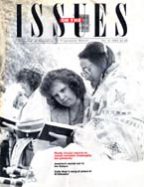
Pictured left, Anna (Maya Angelou) with finn (Wynona Ryder) and Hy (Ellen Burstyn
Well, when women's films are written, directed, and produced by women, can we expect a more honest picture of women's lives? With the recent release of How to Make An American Quilt, the unfortunate answer is no.
Quilt has a simple plot. Finn (Winona Ryder), after accepting a marriage proposal from live-in boyfriend Sam (Dermot Mulroney), goes off to visit grandma (Ellen Burstyn) for the summer to find the inspiration to write her college thesis on "Women and Ritual." Grandma lives with her recently widowed sister (Anne Bancroft) and together they spend their nights quilting in the company of a group of local women (Jean Simmons, Kate Nelligan, Alfre Woodard, and Lois Smith), guided by the creative scrutiny of Maya Angelou. When Finn arrives she learns that the group is working on her wedding quilt with a devotion, love, and commitment that Finn isn't sure she has for her own impending marriage. While swimming at the local pool she is sexually drawn to "a major hunk" and begins to question her desire to marry Sam. The intimate stories of the quilting women are supposed to help Finn in her quest to learn about love, loss, jealously, adultery, and the ups and downs of marriage.
"Is it better to marry a friend or a lover?" Finn asks the single, bohemian Alfre Woodard. "I would marry my soul mate," Woodard replied, clutching a tattered piece of paper that we soon learn contains a poem written by a man she met years ago in a Paris restaurant. After an evening of joyous conversation, she knew he was her soul mate; what she didn't know was that he was married and she would never see him again. So instead of delving into the interesting "friend vs. lover" question, the viewer is left to ponder: "What happens if you meet your soul mate and he's married?" That, in a nutshell, is what is wrong with the script of Quilt. It tries to impress by raising deep questions of the soul but answers them with irritatingly wooly thinking.
Quilt teases us with the promise of a sumptuous feast of strong, independent, inspiring actresses, but instead serves up a hash made from the lives of women who define themselves solely by the men they have loved or lost. Jean Simmons's character is the long suffering wife of an artist who has been unfaithful from the day they married, justifying his adultery by the artists' "need" to "share in all the world's beauty." She stays, turning her anger inward, because he loves her and finds her the most beautiful of all! The moral: A good woman is the thread that holds the marriage quilt together, no matter how frayed the edges, self-respect be damned! Granted, women of the prefeminist generation had limited choices.
But the young Finn, too, proves that no matter how liberated we have become, regardless of our diversity of choices, women still define their existence by men. Pass me the tissues, this IS a threehanky cry!
How to Make An American Quilt trailer
Another subtle, dangerous element of the film is that the two African American women, Maya Angelou and Alfre Woodard, who play mother and daughter, are the only women who love a man for a brief moment and then do without him for the rest of their lives. What's the message here? That women of color aren't good enough to sustain a long term relationship other than that of mother and child? In Hollywood, the caged bird not only doesn't sing, she sleeps alone forever!
Then there's the whole idea of women and ritual, evoked here by the art of quilting, by Finn's college thesis, and, of course, by the ritual of marriage. But the thread unravels without leaving us with any insight into the importance and meaning of ritual in the lives of women. The movie co-opts the idea that during the time of the Goddess women were fully empowered and ritual was often used to express true feelings about magic and the totality of life. In the film, however, the only worthwhile ritual for today's women is one that celebrates and supports traditions that have been established by men. The group's commitment to finishing the wedding quilt is a ritual that symbolizes their unwavering commitments to men, dead or alive, regardless of the emotional and spiritual consequences. When Finn finally finishes her thesis, the pages are blown all over town during a sudden windstorm. At the same moment, miraculously, her wedding quilt is finished, suggesting that only a commitment to a man pays off in the end. Certainly this film offers no ritual expression of joy at being a woman or celebration of our varied choices.
Jocelyn Moorehouse has done an adequate directing job, but falls short in flushing out the nuances of female bonding. She always goes for the obvious style without substance-and permits her women characters no depth. The strength of the ensemble acting of the amazing actresses helps create a patchwork of believable moments. But, as a whole, this Quilt left me cold.
The Cafe
Newest titles:
We’re now taking comments!
Enter the Cafe

CURRENT ISSUE
Spring 2012
Bodies in Motion: Physical Females Face Different Risks by Eleanor J. Bader
Curious Tension: Feminism and the Sporting Woman by Susan J. Bandy
Cheering or Being Cheered? My Daughter's Cheerleading Adventure by Lu Bailey
Who Owns Sports? Dissecting the Politics of Title IX by Martha Burk
Why Sex Segregation Is Bad for Society by Alex Channonk
Films Lag in Sharing The Women's Game by Ariel Dougherty
A Soccer Dad Faces Parenting, Coaching and Dreams by Mauricio Espinoza
Yoga Frontiers: Women Shape Practices in Exceptional Ways by Molly M. Ginty
The Rise and Fall and Possible Rise of Women's Pro Soccer by Tim Grainey
Winning the Sports Beat: Female Writers Need Wide Angle Lens by Marie Hardin
Opening Historic Trails: Accidental Heroes Stomp Sports Inequity by Risa Isard
Girls, Women, Sports: What to Read - by Chané Jones and The Feminist Press
Women On High: The Price of Passion at the Roof of the World by Jennifer Jordan
Athletically Disinclined: My Counterpoint by Gabrielle Korn
Goalposts: Tackling the Last Bastion of Male Monopoly by Andrew D. Linden
Aspiring for Medals: Watching New Gymnastic Generations by Zerlina Maxwell
Athletes and Magazine Spreads: Does Sexy Mean Selling Out? by Laura Pappano
Rules Put Extreme Pressure On Transsexual Players by Lindsay Parks Pieper
Olympics' Coverage Still Shortchanges Female Athletes by Jane Schonberger
Leaping, Racing, Spearing: The Female Athlete Amazes in Myth by Laura A. Shamas
Becoming Glory: Kicking Goals to Transcend the Night, A Memoir by Christine Stark
Nine Titles Thinking About Title IX by Rachel Toor
From Our Archives: Related Stories on Girls, Women, Sports
The Poet's Eye From Poetry Co-Editor Judith Arcana
Related Stories: Bold Discussions of ABORTION in On The Issues Magazine by The Editors
The Art Perspective: Karen Shaw curated by Linda Stein