



















Join On The Issues

Receive information and updates via email.

On You Tube

Visit On The Issues Magazine's YouTube Channel

Send us links to your favorite, progressive videos to add to our favorites

Featured Video:

Featured Video: Intimate Wars by Merle Hoffman
OTI Online
Winter 1998

Gaining Face
The Buckshot In My Cheek Shattered My Personality
by Jenifer Kay Hood


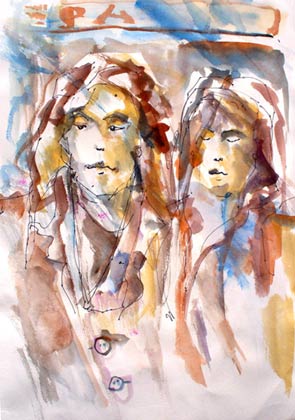
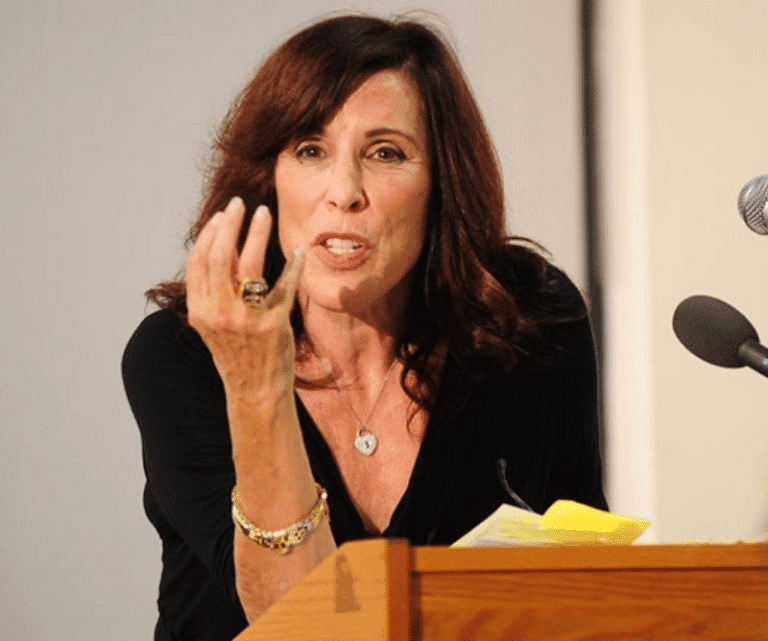
Judy Schavrien's studio is a three-dimensional collage of art books, paint tubes, canvases, jars of mediums and paintings, some finished, others not. "This is a self-portrait from before I was mugged," she says, gesturing toward a portrait of a woman. While the face reveals a civilized mind and the personality shows through in the eyes, the soul seems contained, almost as if it were on a leash. "It's in a style that's pleasing to many and was, of course, to me at the time. Correct. Meticulous."

Judy Schavrien, left, and her correct and meticulous self-portrait, right. American Dream, right, an example of the changed style.

When Schavrien was shot in the face by a mugger 10 years ago, she felt as if in that moment she had lost everything: an intimate 16-year relationship, her sense of success and standing in the community, her closeness to friends who could not dwell in the valley of death with her. She lost not only her physical face, but her social one as well. "Our personality sits in our face," says Schavrien. 'Your ways of seeing yourself, of thinking about yourself, are in the mouth, the eyes, and facial muscles. The buckshot in my cheek shattered my personality."

From that instant she stopped portraying this socially constructed sense of personality on the canvas. Wiping the bright colors from her gloved hands, she continues animatedly, "Personality is a social fiction. These days I intend my work to be about a presence and vitality that is all the more poignant because ifs so transient: you are born; you die. So that the features on the face are like iron filings on a force field."

Pointing to a luscious pastel whose subject seems to be suspended in a moment of passion, she continues, "I hope I convey that in the portrait of Myeongsuk. She was fire with a touch of ice. Here's the anguish and ecstasy in her neck and brow and the overripe sensuality in her lips - a hint of something as yet unstated. The face is translucent, the bronze of her skin emerging from the bronze of the background. Myeongsuk posed like a dancer, the light as her partner."

In "Let's Chat, I'll Give You the Lowdown," Schavrien portrays an African-American friend who became a particular ally after the mugging. "She talked tough, but she had a powerful mind and a mother's heart. She knew how to reassure me when I confessed I crossed the street when I saw possible gang kids. I was sad about it, hated to give insult as much as I hated to get it. She told me, "Honey, when I'm on the street at night I don't let nobody get near me. NOBODY!1"

Portrait of Myeongsuk

In "Don't Go!" Schavrien transforms a print from Kathe Kollwitz's famous series on a woman welcoming death into an impasto about a survivor with a terror of abandonment. 'Part of post traumatic stress," the artist notes, "is that you're alone in your experience. And you feel you will be destroyed by that aloneness. I tell my clients that if you want to heal, you have to reenter the pain again, and work through it" "American Dream -IfYou Suffer, I Suffer" brings a nightmarish ambiguity to the idealzed Norman Rockwell version of American life. In the work, the artist used her own features for the numbed and hollowed-out Caucasian in the background, while the anguished JewishLatina-Arab woman in the foreground evolved from the features of a blond model. "I read her bones, not her personality as she imagined it," Schavrien says. "I really was reading the buried pain and strength in her. In the dramatic and unnerving "Otiano", the subject's raw energy seem to meet Schavrein's head on. "When the nakedness of the model is met by the nakedness of the artist," says Schavrien, "that's when the expression is forthright." The people I portray have eyes that see past surfaces," Schavrien remarks. "They have natural forces running through them as if they are translucent. It's art that gives you permission to feel." "The physicality of being a painter makes me happy,"

Schavrien continues, as her hand arcs across a canvas. "Most often m use my fingers or a palette knife." Rubbing her hands in the I paint and reveling in color reminds Schavrien of the Fool in King Lear who says the Great Day will have come "when feet shall go with walking." Schavrien points out that it may take a lot to persuade someone to get back into her feet enough that her toes feel welcomed by the grass, But according to the artist's Buddhist beliefs, coming back to the physicality of your body is essential, if you are to find your natural mind.

"Tibetans describe this panoramic natural mind so well," I Schavrien explains. "They call it the View - you don't just look at the View, you rest in it, you are it. They are mountaintop people so they understand such things. But my point is that they not only have mountaintop eyes, they have sturdy legs."

Schavrien has become convinced that traditional therapy is only the beginning of a healing process that must also occur on a physical, social and spiritual level. "It's fatal to be a therapist who knows nothing but the psychological world view," the artist remarks. "It couldn't be more impoverishing. I'm multi-lingual in the number of cultures I've lived in and the number of art and healing languages I know. So I never make I the mistake of accepting psychotherapeutic language as the only truth. People must break out of their social fictions even if they're the fictional absolutes of therapy."

Taking a stand on hospitals and meaning it by Lois Uttley
"Otiano"

A writer and performer, Jenifer Kay Hood is the author of the one-woman show Fatal Interview, and one of the writers of the Emmy-nominated documentary Ishi: The Last Yahi. She was recently awarded Best Feature by the California Newspaper Publishers Association.


© 1998 - 2010 On The Issues.

The Cafe

deepening the conversations by continually adding the insights of progressive writers.

Newest titles:

Content on this page requires a newer version of Adobe Flash Player.

Get Adobe Flash player

We’re now taking comments!

Enter the Cafe
The Cafe at On the Issues Magazine

CURRENT ISSUE
Winter 2012

Realities of The Waiting Room: Constantly Shifting by Lori Adelman

Anti-Abortion Harassment and Violence Still Stifle Access by Eleanor J. Bader

We're Not Sorry. Still. by Jennifer Baumgardner

The Poet's Eye From Poetry Co-Editor Sarah Browning

Calling Black LGBTQ Institutions: Where Are You? Where is Reproductive Justice? by Jasmine Burnett

Privacy at Stake: Patients, Clinics and Electronic Medical Records by Corinne A. Carey

Can We Choose Move Forward on Reproductive Justice? -- And How? by Ayesha Chatterjee and Judy Norsigian

"Love Means Second Chances": Reproductive Freedom in a Novel by Susan Elizabeth Davis

Satirist's View: Same Old Dilemma, or The Virgin Rebirth by Susie Day

As Access Slides, Feminists Need to "Extract" From Our Self-Help Past by Carol Downer

Abortion: On The Issues Magazine - by The Editors

How Anti-Abortion Protesters Got Me: Letter From a Young Activist by Sarah Flint Erdreich

The Grand Folly of Focusing on "Common Ground" by Gloria Feldt

Before "Roe": Legal Battles, Involuntary Servitude, My Mom by Justine Goodman

Next Generation Access: Medical Students Fill A Void by Mary Lou Greenberg

The Power of Theater: "Words of Choice" Touches Hearts by Alexis Greene

Where the Reality of Abortion Resides: Intimate Wars by Merle Hoffman

Gone Too Far? Reproductive Politics in the Time of Obama by Carole Joffe

Lila Rose: A Sweet Face to Accompany Extreme Anti-abortion Claims by Kathryn Joyce

Glorifying the Fetus While Ignoring the Fetal Environment by Margie Kelly

Reframing Compassionate Care: Of Madame Restell and Other Outlaws by Jeannie Ludlow

Helping Bloggers To Help: Tips for Reproductive Health Organizations by Amanda Marcotte

What To Do When They Say Holocaust by Carol Mason

"Silent Choices": African American Women Open Up on Film by Faith Pennick

Fine Thoughts On Fertilized Personhood by Marge Piercy

Heading Toward Menopause, Still Caring about Abortion by Andrea Plaid

Letter to a Young Activist: Don’t Drop the Banner by Barbara Santee

Redefining Chutzpah: More Bad Ideas to Burden Women by Aram A. Schvey

Sharing the Wealth of Knowledge on Abortion by Ria Sen and The Feminist Press

An Abortion Miracle? Let's Try the First Amendment by Priscilla Smith

Related Stories: Bold Discussions of ABORTION in On The Issues Magazine by The Editors

The Art Perspective: Ursula O'Farrell curated by Linda Stein

Student Think Tank

Winter 2012 Index

Print page      Bookmark site      Rss Feed RSS Feed


©1983-2012 On The Issues Magazine; No Reuse without permission. • Complete Table of ContentsPrivacyLinks of Feminist and Progressive Interest