






















Join On The Issues

Receive information and updates via email.

On You Tube

Visit On The Issues Magazine's YouTube Channel

Send us links to your favorite, progressive videos to add to our favorites

Featured Video:

Featured Video: Intimate Wars by Merle Hoffman
OTI Online Spring 2009 edition Lines in the Sand

Higher Ground, Not Common Ground
by Merle Hoffman

“DRAW A LINE IN THE SAND”
Etymology: based on the idea of literally making a mark in the sand to show someone they cannot move across it.


As a person who feels that war should be the strategy of last resort, I still like to read military history. I find myself going back to the wisdom of Sun Tzu who wrote in “The Art of War” in the 6th century BC: “If you know the enemy and know yourself, you need not fear the results of a hundred battles.”

As feminists who fight battles against those who would deny women’s freedom and equality, we know the mettle of our enemies. They are relentless, committed beyond secular principles, willing to look at things in the very long term, absolutely sure of their righteousness and totally determined.

They have one solid line, which they define and defend. Those who stand on their side are with the angels; those who stand on the other are misguided, at best, and sinners, at worst.

One battle or many do not determine who will ultimately triumph in any war. From the civil war in the U.S., the suffragist struggle for the vote, the ongoing battle for reproductive rights and all other revolutionary movements in the world, history shows that nothing is achieved once and for all.

Movements are not static, formal things -- freedom and justice are generational struggles that are passed down and through the ages. The movement for women’s liberation is a Protean force that contracts, expands and expresses itself, directly and, at times, in camouflage, depending on the current theater of struggle.

The strength of the movement is that it can shape-shift—situationally compromise, accept new technologies, ways of communicating and influence-- all in service of a vision. The vision itself remains universal -- beyond cultures and national boundaries.

Feminists may need to practice realpolitik to get the “least bad” candidate elected and the needed bills vetoed or passed. The ideologist asks the question: “Is it good for women?” The politician asks: “Is this the best we can do for women now?” The visionary holds to a higher standard, and takes the longer view.

Because strategies and tactics change in response to the political and historical moment, those who view feminism’s existence purely in terms of realpolitik sometimes wonder if the movement still exists – and, if so, to what end.

For instance, the present public discussion of the need for “common ground” in the abortion debate is a reflection of the Obama Administration’s attempted conciliation or reconciliation between adversarial parties. So far, the discussion has talked about reducing the need for abortion.

Our Bodies on the Line

Pro-choice advocates cannot enter this process in a political vacuum that discounts the deep antipathy anti-choice forces have towards women’s power and sexuality. I firmly believe that there can be no common ground with those who consider the Pill to be “chemical warfare,” and abortion to be a moral sin greater than the rape of a nine-year old.

These discussions place the pro-choice movement more on the verge of capitulation than conciliation.

"This much injustice and no more."

But this does not argue for the demise of the vision of reproductive justice. Indeed, reproductive freedom is the front line, the bottom line and the everlasting line in the sand of any definition of women’s transcendent rights that must be continually defended.

All rights start with the body. We are embodied creatures -- and women far more than men because our reproductive abilities are the source, the core, the prime objective of society’s control and oppression of us.

Theory must become practice at one point in time. Our bodies are the place where the power structures make their marks with their laws, their religions, traditions and their prejudices.


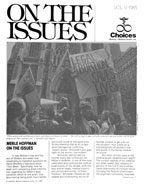
Members of the NY Pro-Choice Coalition hold a proclamation outside St. Patrick's in NY, 1989.

Our bodies are lines in the sand. Each one of us proclaims that the power of the state stops at our skin when we lay our bodies down for an abortion, saying, with that action, that it is we who will decide when and whether to bear children. Or when we leave a violent relationship. Or when we resist and when we take the right to sexual pleasure. And when we declare that we must live in freedom.

When you draw a line in the sand, you have got to be prepared to defend it, to take risks and embrace challenges. That, too, calls upon the body, as well as the body politick.

Here We Stand

Rosa Parks and Alice Paul put their bodies on the line, saying, “This much injustice and no more.” So did all of the providers of abortion services who risked their lives and freedom before abortion was legal, and those who continue to risk their lives by just doing their work on a daily basis.

Perhaps Martin Luther expressed this perspective best after he nailed his 95 Theses on the doors at Wittenberg in 1517: “Here I stand; I can do no other.”

That act was an inspiration 20 years ago when I led the first pro-choice civil disobedience at St. Patrick’s Cathedral in New York City on April 29, 1989. Pro-choice activists were arrested for the first time in the movement’s history. We declared that “women’s rights are in a state of emergency,” and we held our petition at the cathedral door.

The petition’s words carry a message today for those stepping onto the shaky sand of common ground. It said:


We stand here today to affirm the following to Cardinal John J. O’Connor who has blessed, praised and hosted the anti-abortion fanatics of “Operation Rescue”:

That you have consistently turned a deaf ear and a cold heart to women by repeatedly ignoring urgent requests to meet with us about the terrorism and violence towards women that “Operation Rescue” represents;

That you have added to the atmosphere of fear, terror and anxiety that women must face when attempting to exercise their constitutional right to an abortion;

That you have encouraged the fanaticism and women hating that feeds the politics of “Operation Rescue;”

Now, therefore, we stand here not as beggars at your gate, but as people of conscience to affirm that:

I. Women are full moral agents with the right and ability to choose when and whether or not they will be mothers.

II. Abortion is a choice made by each individual for profound personal reasons that no man nor state should judge.

III. The right to make reproductive choices is women’s legacy throughout history and belongs to every woman regardless of age, class, race, religion or sexual preference.

IV. Abortion is a life-affirming act chosen within the context of women’s realities, women’s lives, and women’s sexuality.

V. Abortion is often the most moral choice in a world that frequently denies healthcare, housing, education and economic survival.

I am convinced that the seeds for an unapologetic women’s movement are in the bones and the blood of all of us. It should come alive every time one of us is raped, one of us is stoned, burned alive, killed by a loved one, forced to give birth or to kill our female offspring.

That is what we must know about ourselves -- that each of us holds that power. We may have to e-mail each other on the nature and location of the battle, but in the end, we know that we all must put our real bodies on the line and reject common ground in order to reach the higher ground of our vision.


Merle Hoffman is the Publisher and Editor-in-Chief of On The Issues Magazine. She is the Founder, President and CEO of CHOICES Women’s Medical Center.

For more Merle Hoffman Editorials

Also see Revolution Lite by Merle Hoffman in the Winter 2009 edition of On The Issues Magazine.

Also see Mobilizing for Reproductive Justice by Loretta Ross in this edition of On The Issues Magazine.

Also see "RUINED" by Lynn Nottage Links War, Horror and Prostitution, a Preview by Alexis Greene in the Summer 2008 edition of On The Issues Magazine. RUINED was awarded The Pulitzer Prize for Drama in April 2009.

The Cafe

deepening the conversations by continually adding the insights of progressive writers.

Newest titles:

Content on this page requires a newer version of Adobe Flash Player.

Get Adobe Flash player

We’re now taking comments!

Enter the Cafe
The Cafe at On the Issues Magazine

CURRENT ISSUE
Winter 2012

Realities of The Waiting Room: Constantly Shifting by Lori Adelman

Anti-Abortion Harassment and Violence Still Stifle Access by Eleanor J. Bader

We're Not Sorry. Still. by Jennifer Baumgardner

The Poet's Eye From Poetry Co-Editor Sarah Browning

Calling Black LGBTQ Institutions: Where Are You? Where is Reproductive Justice? by Jasmine Burnett

Privacy at Stake: Patients, Clinics and Electronic Medical Records by Corinne A. Carey

Can We Choose Move Forward on Reproductive Justice? -- And How? by Ayesha Chatterjee and Judy Norsigian

"Love Means Second Chances": Reproductive Freedom in a Novel by Susan Elizabeth Davis

Satirist's View: Same Old Dilemma, or The Virgin Rebirth by Susie Day

As Access Slides, Feminists Need to "Extract" From Our Self-Help Past by Carol Downer

Abortion: On The Issues Magazine - by The Editors

How Anti-Abortion Protesters Got Me: Letter From a Young Activist by Sarah Flint Erdreich

The Grand Folly of Focusing on "Common Ground" by Gloria Feldt

Before "Roe": Legal Battles, Involuntary Servitude, My Mom by Justine Goodman

Next Generation Access: Medical Students Fill A Void by Mary Lou Greenberg

The Power of Theater: "Words of Choice" Touches Hearts by Alexis Greene

Where the Reality of Abortion Resides: Intimate Wars by Merle Hoffman

Gone Too Far? Reproductive Politics in the Time of Obama by Carole Joffe

Lila Rose: A Sweet Face to Accompany Extreme Anti-abortion Claims by Kathryn Joyce

Glorifying the Fetus While Ignoring the Fetal Environment by Margie Kelly

Reframing Compassionate Care: Of Madame Restell and Other Outlaws by Jeannie Ludlow

Helping Bloggers To Help: Tips for Reproductive Health Organizations by Amanda Marcotte

What To Do When They Say Holocaust by Carol Mason

"Silent Choices": African American Women Open Up on Film by Faith Pennick

Fine Thoughts On Fertilized Personhood by Marge Piercy

Heading Toward Menopause, Still Caring about Abortion by Andrea Plaid

Letter to a Young Activist: Don’t Drop the Banner by Barbara Santee

Redefining Chutzpah: More Bad Ideas to Burden Women by Aram A. Schvey

Sharing the Wealth of Knowledge on Abortion by Ria Sen and The Feminist Press

An Abortion Miracle? Let's Try the First Amendment by Priscilla Smith

Related Stories: Bold Discussions of ABORTION in On The Issues Magazine by The Editors

The Art Perspective: Ursula O'Farrell curated by Linda Stein

Student Think Tank

Winter 2012 Index

Print page      Bookmark site      Rss Feed RSS Feed


©1983-2012 On The Issues Magazine; No Reuse without permission. • Complete Table of ContentsPrivacyLinks of Feminist and Progressive Interest